Committee Head Participates in Public Presentation of Council of Europe Analytical Report
During the event, participants discussed approaches to creating an effective mechanism for reasonable accommodation of workplaces, the procedure for interaction between an employee and an employer, state support for employers, and further steps to improve legislation.
Updated: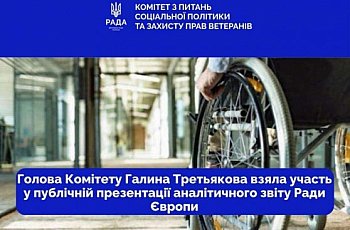
On October 8, 2026, Halyna Tretyakova, Head of the Verkhovna Rada Committee of Ukraine on Social Policy and Protection of Veterans' Rights, took part in the public presentation of the Council of Europe analytical report on Draft Law of Ukraine No. 14389 "On Amendments to the Law of Ukraine 'On the Basics of Social Protection of Persons with Disabilities in Ukraine' regarding the Improvement of the Reasonable Accommodation Enforcement Mechanism" and its compliance with European standards.
During the event, participants discussed approaches to creating an effective mechanism for reasonable accommodation of workplaces, the procedure for interaction between an employee and an employer, state support for employers, and further steps to improve legislation.
Halyna Tretyakova emphasized that the development of reasonable accommodation mechanisms is an important component of ensuring the right of persons with disabilities to work and their full participation in public and economic life.
"The League of the Strong Public Union is an example of how one can defend the interests of persons with disabilities in partnership with the state. As a result of such a partnership, persons with disabilities become more independent and can live their lives with dignity, including professionally," the Committee Head noted.
She recalled that the UN Convention on the Rights of Persons with Disabilities, in particular Article 27 on labor and employment, was ratified by Ukraine in 2008. At the same time, according to Halyna Tretyakova, despite the ratification of the Convention, Ukrainian legislation still requires proper regulation of reasonable accommodation mechanisms.
The Committee Head dwelt separately on how the procedure for an employee's request to the employer regarding the arrangement or rearrangement of a workplace should function.
"The law gives the right to any person with disabilities working at an enterprise to contact the employer with the issue of rearranging the workplace," Halyna Tretyakova explained.
According to her, the proposed bill stipulates that after such an appeal, within five days, the employer, together with the employee, must determine how the workplace should be rearranged taking into account the specific needs of the person.
"Five days is not meant to arrange the workplace. It is impossible to arrange a workplace in five days. At the same time, within five days, the employer and the person must sit down, gather and discuss how the workplace should be rearranged for a specific disability," the Committee Head noted.
Halyna Tretyakova drew attention to the fact that the needs of people with disabilities are diverse, and therefore decisions on reasonable accommodation must be determined individually, taking into account the functional capabilities of a specific person.
She also emphasized the need for a clear role of the state in this process, in particular regarding the provision of professional recommendations on the necessary equipment and minimum standards for workplace arrangement.
"Disabilities vary. And accordingly, the equipment can be quite diverse," Halyna Tretyakova emphasized.
An important element of the proposed mechanism is state financial support. According to the Committee Head, the employer should not be left alone with the costs of workplace rearrangement.
"The state will help. The employer is not left alone here with the resources for rearrangement," she noted.
Halyna Tretyakova also reported that the bill provides for the possibility of applying for rearrangement not only by the employer, but also by the person themselves, in particular in cases involving self-employed persons or sole proprietors.
Particular attention during the speech was paid to control mechanisms designed to prevent the inefficient use of public funds. In particular, control is envisaged to ensure that funds received for reasonable accommodation are actually used for their intended purpose.
"The law also has a safeguard against deception, when an unscrupulous employer took the money and did not rearrange such a workplace. That is, there is such a safeguard for unscrupulous employers, and this prevents inefficient spending of public funds," the Committee Head emphasized.
Halyna Tretyakova also drew attention to the prospect of creating a register of rearranged workplaces, which, in her opinion, would in the future allow people with disabilities to see available employment opportunities in different regions of Ukraine.
"We probably need to create a register of such rearranged workplaces in 'Diia' as well, so that it is clear for a person with disabilities living in any city or town of Ukraine where such jobs are vacant. We will work with the Minister of Digital Transformation of Ukraine Furchuk Oksana on this bill," she noted.
According to her, such an approach will allow not only preserving the already created conditions, but also connecting an employee with disabilities and an employer who is ready to provide appropriate working conditions.
The Committee Head emphasized that during the preparation of the bill for the second reading, it is necessary to take into account expert recommendations and develop additional mechanisms for its practical implementation.
She stressed that the effectiveness of legislative changes will depend not only on their adoption, but also on high-quality implementation at the level of the Cabinet of Ministers of Ukraine and relevant state authorities.
"We need this success to be convincing, and people to work in decent jobs," the Committee Head concluded.