"Населення України має отримувати воду, яка відповідає встановленим вимогам безпеки та якості": Голова Комітету on Environmental Policy and Use of Олег Бондаренко on the New Water Quality Control System and European Standards
Recently, Law No. 4978-IX came into force, which is part of the European integration changes in the field of drinking water supply and sanitation.
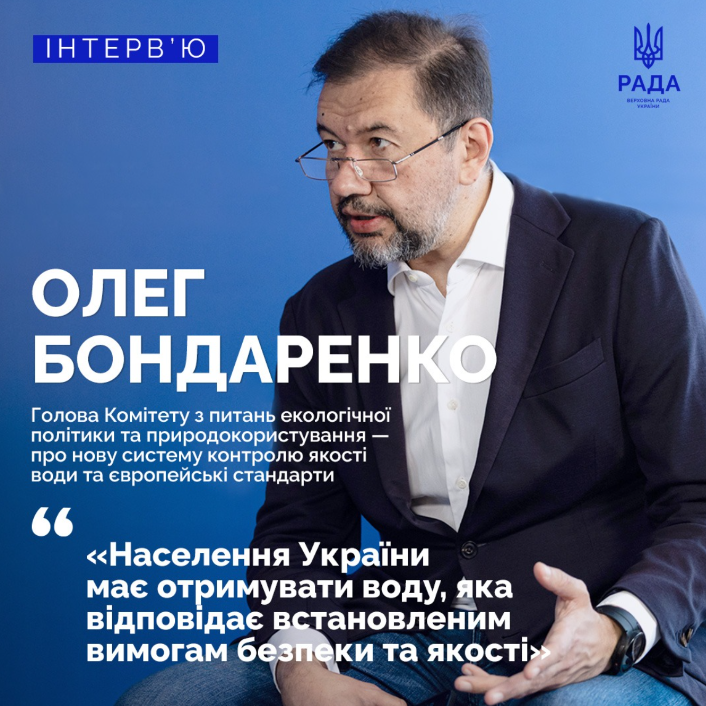
Голова Комітету on environmental policy and use Олег Бондаренко in an interview with Пресслужбі Апарату Верховної Council spoke about the new water quality control system and what systemic problem it should solve.
- Law No4978-IX is part of the European integration changes in the field of drinking water supply and sanitation. What is its fundamental novelty and what systemic problem should it solve?
- This law is not the first step in bringing Ukrainian legislation in the field of water supply and sanitation to European standards. Over the past years, we have been consistently working on this direction.
I will say frankly: this process intensified during a full-scale invasion. We have already adopted legislative changes on the features of wastewater disposal, and also adopted an updated version of the law on water supply. Its new stage.
- Instead of responding to the already detected pollution, the law provides for a risk-based approach - that is, potential risks to water quality should be detected in advance. How will this approach work in practice?
The water-based approach differs from the current practice in that it is necessary to control the water quality of the system, which allows not only to respond to the problems identified, damage or unsatisfactory water quality, but also to determine potential threats in advance.
Now we mainly rely on the results of monitoring and research of water received by the population. Instead, the risk-based approach involves a comprehensive control system - from the water supply source to the consumer.
- The law allows temporary deviations from individual requirements for the quality of drinking water. Under what circumstances is this possible and does such a deviation mean that water can be dangerous for consumption?
First of all, this is not a Ukrainian innovation, but an approach provided for by the relevant European directive, the provisions of which are not applicable at all. The possibility of a temporary indentation is provided for clearly defined cases.
For example, when it is impossible to ensure compliance of water with the established requirements in a certain period. Another situation is a man-made disaster that may damage the existing system.
- If a person is faced with a problem of water quality, regular interruptions in water supply or drainage, which body should he contact?
First of all, the responsibility for the provision of services lies with the entities that carry out water supply and wastewater management. These can be state, private or municipal enterprises, in most cities it is about municipal water utilities.
Between the water supply and the consumer, a contract is concluded that determines the terms of service. Therefore, the first step in the event of a problem should be to address the relevant enterprise with the requirement to eliminate shortcomings.
- How will the law change the rules for connecting to centralized water supply and sanitation systems? What is provided for non-centralized systems, in particular septic tanks and local treatment facilities?
Connection to centralized water supply will be carried out in accordance with the capabilities of the water supply system, the organization that provides water supply and the conditions under which it can provide connection.
If we are talking about non-centralized water supply or water supply, then this is a private activity. The most important thing we have done in the field of water supply and sanitation is to create prerequisites for such activities, in particular in the private sector.
Кабінету Міністрів України. In general, until now, this activity has not been systematized. We have systematized it with new norms and new legislation and made it possible to implement it in accordance with the legislation.
- How will the new legislation regulate the situation when as a result of Russian attacks, man-made accidents or damage to infrastructure, water becomes unfit for consumption or its supply stops?
However, the mechanisms of emergency response to water needs to be provided even before the adoption of this law. They belong to a separate area of regulation, which covers emergency response in the field of water supply, sanitation, electricity and other housing and communal services.
Unfortunately, in the conditions of war, such situations have become especially relevant due to attacks of Russian drones, missile strikes and combat actions. Therefore, this law does not establish a separate one.
- Can the implementation of European water quality standards affect tariffs for centralized water supply and sanitation for the population and business?
Thus, it is necessary to provide water services, the necessary investments and their cost to the water supply system. It is not only water supply and sanitation, but also other areas, including waste management.
This is also one of the areas that is covered by the Committee on Environmental Policy and Environmental Protection. All these areas require significant investments, modernization and infrastructure development.
- What changes are envisaged in the interaction between water utilities, local authorities and НКРЕКП? Who will determine the tariffs after the law comes into force?
Interaction system НКРЕКП and water utilities have not changed, and this was one of the prerequisites for the adoption of the law. Before its adoption, we held a series of consultations and round tables with the participation of НКРЕКП, water utilities and community associations.
Based on the results of these discussions, we have determined how the system should work. Communal enterprises and local self-government bodies will be able to set tariffs. At the same time, the methodology of tariff formation, mechanisms for approving tariffs and monitoring compliance with the relevant methodology will remain in the field of competence НКРЕКП.
We have moved as far as possible away from the approach in which the state directly determines the cost of a particular service, and strengthened the role of local authorities. At the same time, this implies responsibility for fulfilling the requirements of the law and ensuring the proper quality of services.
This approach was supported by representatives of local authorities, industry and НКРЕКП. Finally, the law received support and Верховній Раді during the voting in the second reading. In our opinion, this system should ensure the proper provision of services.
However, other prerequisites are needed for this. First of all, the end of the war, because the expected results can be negated as a result of enemy strikes on water supply and sanitation facilities.
The second important factor is significant financial resources necessary for the modernization of the infrastructure. We count on coordinated actions of the state authorities Європейського Союзу and other international partners.
The entire system of housing and communal services needs significant investment. It is not only about water supply, but also about sanitation, that is, sewage, and waste management. We will be able to implement the necessary changes with the support of ЄС and other partner countries.
Similar assistance was received by other countries that joined the Європейського Союзу: grants, soft loans and financing for infrastructure modernization and implementation of European standards.
After all, the quality of life and utilities is what our citizens expect, and one of the prerequisites for the further development of the economy of Ukraine.
Sources and photo
Photo source: Верховна Рада України · новини · CC BY 4.0 · Original photo